妥了... 政府将收回更多组屋,在99年屋契到期之前就重新发展这些组屋
功夫熊猫 • • 28292 次浏览21:19 8频道新闻
总理说,在30到40年后,我们会重建目前的市镇,成为未来的马林百列、宏茂桥、勿洛等,这些社区才能保持活力,并拥有能符合广大需求的设施。建屋发展局将会很忙,可能改名为HRB:建屋重建局。
- 0
- 0
21:15 8频道新闻
总理宣布,政府将开展一个新的、自愿的旧组屋区重新发展计划“自愿提早重建计划”VERS,屋龄届70年会获选,计划将在20年后展开。屋主会得到赔偿,获配新组屋。
- 0
- 0
21:12 8频道新闻
总理宣布更多家庭能够在屋契到期前,获得重新发展的机会。因为政府将收回更多组屋,在99年屋契到期之前就重新发展这些组屋。
- 0
- 0
21:11 8频道新闻
总理说,需要花20到30年的时间分批重新发展旧市镇,而不是四到五年的时间,这些市镇才不会在同一时间,再次成为建筑工地。
- 0
- 0
21:08 8频道新闻
总理宣布,组屋到了60或70的屋龄,将可有第二轮的翻新,也就是家居改进计划II。
- 1
- 0
21:08 8频道新闻
总理宣布,将扩大现有的家居改进计划HIP,这将包括1997年之前建造的组屋,另外23万个组屋的屋主将受益。白沙、义顺、淡滨尼、裕廊等新镇将参与计划。
- 4
- 0
21:07 8频道新闻
总理说,这也是为什么,不只是组屋,政府也只售卖99年地契的私宅地皮。很多旧楼的屋龄还不到50年,就看起来非常老旧,过了一世纪,它的机电系统也将是过时的,维修的费用也将非常高,因此最好还是让屋契到期,拆除建筑物,再重新建楼。
- 0
- 0
21:07 8频道新闻
总理说,组屋屋契为什么是99年的基本原因是因为,我们必须对下一代公平。你买了99年屋契的组屋,把它传给子孙,之后组屋回到政府,政府才能重新发展土地建造新的组屋,并确保下一代能够购买他们的预购组屋。如果政府卖给你永久地契的组屋,我们将缺少土地为下一代建造新组屋。那些没法继承房产的人,将没有住屋,我们的社会将分裂成屋主和无法负担住屋的人士,这将是非常不公平和分裂社会的。
https://goo.gl/crgfTu
-
#1
坡坡政府真的太棒了!沙发坐好,等大家议论
-
#2
PM Lee addresses hot-button HDB 99-year lease issue at National Day Rally 2018
An issue weighing heavily on many public housing-dwelling Singaporeans’ minds has been addressed this National Day Rally 2018.
Advertisement
The NDR 2018 was held at at the ITE College Central, Ang Mo Kio, on Aug. 19, 2018.
This was what Prime Minister Lee Hsien Loong said about the 99-year Housing Board (HDB) flat lease running out and the measures that will be in place to mitigate this eventuality.
Managing expectations: Newer HDB flats won’t experience massive value appreciation
A four-room flat in Ang Mo Kio bought by a first-generation resident for S$25,000, would now be about 40 years old, and can fetch more than S$400,000 in the resale market, more if it is in a good location.
This is a huge appreciation of value.
Even the poorest one-fifth of homeowners each have on average S$200,000 of wealth in their HDB flat, PM Lee said.
Young couples buying a flat today probably won’t see such a tremendous appreciation, because our economy is maturing and can no longer grow as fast.
The oldest flat in Singapore is about 52 years old.
AdvertisementAssuring Singaporeans HDB leases have value despite them running out eventually
PM Lee explained how the remaining lease of a flat can retain substantial value to meet retirement needs.
Singaporeans can continue living in the flat, rent out a room for income if needed, and one day pass the flat down to their children.
Or Singaporeans can right-size, sell the flat and move to a smaller unit.
Or Singaporeans can go for Lease Buyback, and return the remaining lease to HDB, then use the money received for retirement.
To help residents monetise their older flats, the government will expand the Lease Buyback scheme and improve the liquidity of the resale market.
The Ministry of National Development will work on this.
AdvertisementMore reassurances about HDB leases outliving the owners
Very few of today’s HDB owners will outlive their leases
HDB estimates that it will happen to less than 2 percent of households, including those who have bought resale flats.
But it could happen to the buyer’s children if they inherit the flat, but this should not be a problem if the children buy their own BTO flat, with its own 99-year lease.
What will the Singapore government do when leases run out?
If Singaporeans return the flat to the government when the lease expires, the government will help them get another flat to live in.
PM Lee said it may be a Build-To-Order (BTO) flat from HDB with a fresh 99-year lease, if the buyer is eligible for another one.
Or it may be a resale flat on a shorter and cheaper lease.
Or it may be a two-room Flexi flat for retirement.
But whichever option chosen, it is only fair to pay for the new lease.
AdvertisementWhy is lease expiry necessary?
PM Lee then explained the justifications for leases to expire.
The flat returns to the state to allow the government to redevelop the land, and build new flats for future generations.
This is the only way to recycle the land and ensure that all descendants can buy new BTO flats of their own.
If flats are sold without a lease, the owners would pass their flats down to some of their descendants, many generations into the future.
But those not lucky enough to inherit a property would get nothing.
Singapore society would split into property owners and those who cannot afford a property
This is why 99-year leases apply to private housing too.
AdvertisementPractical reason why leases cannot be extended
Buildings suffer from wear and tear at the 50-year mark in Singapore’s tropical climate, and internal electrical wiring might be obsolete in the future.
The recurrent maintenance cost will be very high.
It is easier to demolish and rebuild, than to preserve.
Some important heritage buildings will be preserved, but selectively.
The government has also pledged to keep existing HDB flats liveable and in good condition, despite leases only expiring in a few decades’ time.
New upgrading programme to be launched
The upgrading Home Improvement Programme will be extended.
There are flats that missed qualifying for the original HIP launched 10 years ago and are now starting to show their age at the 30-year mark.
The original HIP covers flats built up to 1986.
The HIP will be expanded to include blocks built up to 1997.
This means another 230,000 flats will benefit.
These flats include those in Pasir Ris, Yishun, Tampines, Jurong and a number of other estates.
AdvertisementTwo upgrading programmes in 99 years
PM Lee said Singapore is determined not to let public housing degenerate into slums, which has happened in many other cities.
There will be a second round of upgrading, at about the 60- to 70-year mark.
It will be called HIP II.
Therefore, every HDB flat can expect to be upgraded twice during their lease.
Once when they are about 30 years old, through the Main Upgrading Programme (MUP) or Home Improvement Programme HIP, and a second time through HIP II when they are about 60 to 70 years old.
The first flats will reach 60 to 70 years old about 10 years from now.
That is when Singapore plans to launch the HIP II programme.
The first HIP will cost the government more than S$4 billion.
HIP II will probably cost even more, because the flats will be twice as old by then.
The final batch of HIP flats will be announced by next year.
Within a few years, all flats eligible for HIP will have been upgraded.
That means altogether 450,000 flats upgraded under MUP plus HIP.
AdvertisementSelective En bloc Redevelopment Scheme (SERS)
PM Lee also explained the rationale as to why Selective En bloc Redevelopment Scheme (SERS) cannot be carried out extensively.
SERS is a very limited scheme meant for selected HDB blocks or precincts, which have high development value that can be unlocked — such as Tanglin Halt.
Because there is a lot of value unlocked, the value is shared with residents through generous compensation.
With generous compensation, acquisition can be made compulsory, which means HDB decides on SERS, and residents don’t get to vote.
HDB estimates that only around 5 percent of flats are suitable for SERS.
But more households will be able to benefit from redevelopment before their leases expire.
Why? Because the government has good reason to take back more flats, and redevelop them as they grow older, before 99 years are up.
By planning ahead, this will prevent the leases in towns that will expire around the same time having all the flats returned to the state within a few short years.
Redevelopment of old towns can then take place over 20 to 30 years, rather than within four to five years — the duration which they were built.
This would start with oldest flats that reach about 70 years old onwards.
This will allow things to be done in a more orderly and measured way.
New scheme to take back flats: VERS
PM Lee then introduced a new scheme that is a derivative of SERS.
The government will take back flats progressively over several decades, starting from 70 years, and stage out the redevelopment.
This new scheme, Voluntary Early Redevelopment Scheme (VERS) will compensate those whose flats are taken back early.
Residents will get to vote on VERS.
https://mothership.sg/2018/08/national-day-rally-2018-hdb-lease-99-year/
-
#3
Voluntary Early Redevelopment Scheme (VERS)
SINGAPORE - Residents in ageing Housing Board towns will get a chance to experience what it is like to go en bloc, in the Government's bid to avoid mass redevelopment of such estates all at one go.
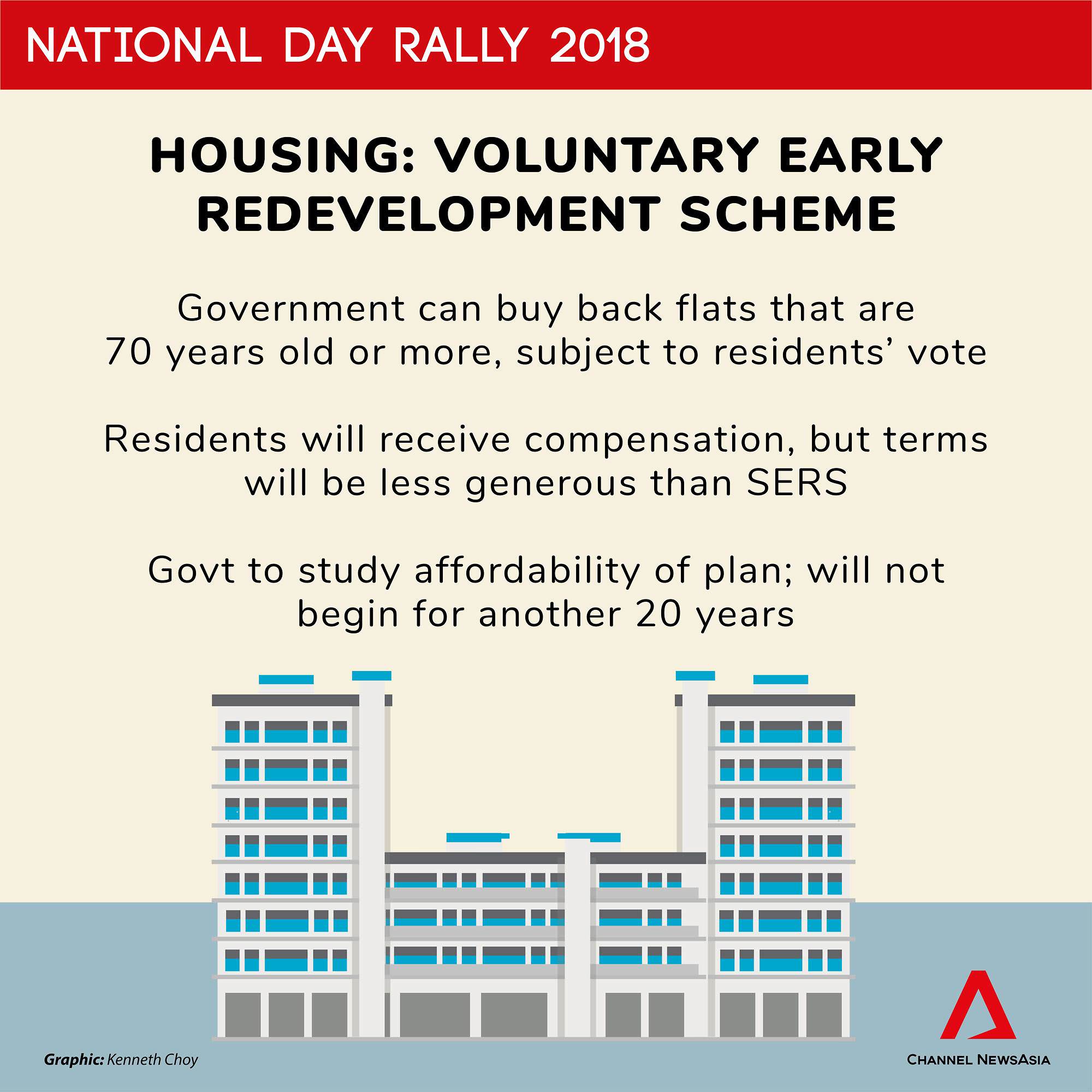
Under the new Voluntary Early Redevelopment Scheme (Vers), to kick in about 20 years from now, owners in flats aged 70 years and older can vote for the Goverment to buy back their homes before their leases run out.
They can use the proceeds to buy a new flat, while the Government redevelops the precinct.
If they vote no, they can continue to live in their flats till the leases run out.
Prime Minister Lee Hsien Loong, in announcing the planned move at his National Day Rally on Sunday (Aug 19), said Vers would allow the authorities to redevelop older HDB towns in an orderly way - paced over two to three decades, rather than crammed in four or five years.
He noted that several older estates, such as Marine Parade, Ang Mo Kio and Bedok, were built within short periods, mostly during the 1970s and 80s.
Without such a scheme, "we will have to find new homes for a lot of people at once," he said.
"HDB will have to tear down and rebuild the old flats in a hurry... These towns will become construction sites all over again, with cranes all over the place," he said.
The scheme, he added, allows redevelopment to take place in a "more measured and considered way".
It also gives more Singaporeans a chance to experience large-scale redevelopment - something previously restricted to those part of the Selective En-bloc Redevelopment Scheme (Sers). Only 5 per cent of flats are estimated to be eligible for Sers.
Unlike Sers, however, the compensation for Vers will be "less generous", as there is less financial upside for the Government to take back these flats early. Eligible Sers flats often have "high development value", where the Housing Board is likely to build more flats in the underutilised plot of land.
Also, unlike Sers, Vers will be determined by a vote.
Mr Lee noted that Vers will not be implemented for another 20 years, adding that the Government needs more time to work out how to select the precincts, space the redevelopments out, what compensation would be and how to afford the scheme for the long haul.
"But I think such a scheme is necessary, and so we will start planning for Vers now," he said.
https://www.straitstimes.com/politics/national-day-rally-2018-two-decades-from-now-residents-in-old-hdb-flats-can-vote-to-let
-
#4
oluntary Early Redevelopment Scheme (VERS)
-
#5
熊猫你能用得上这些好处吗?我看用得上的人不多啊。
70年的房子,继承给孩子们恐怕他们都不会要,或者想办法兑现掉,以免妨碍自己去BTO新的。
组屋确实还是政府的,相比私人房子看似没有人管,但是什么时候集体出售决定权在业主。
还是灵活许多啊。 -
#6
假如政府不再续约土地了怎么办?公寓老了,政府可是不管的。太老的99年的公寓不好买吧。太老了管线,设施都会有问题,估计租都不太容易。前20-30年还可以。
-
#7
理论上有这样的可能性,但是你可以想象一下这样的新加坡会是怎么样的。
所有的房子都是公家房子,没有私人房子。
所以对于新来新加坡工作或者学习的人,要么就是和房主一起住,要么就是住酒店,因为他们没有办法买组屋。
市面上完全没有可以自由出租的公寓,所有居民就一套房子。
这个地方一定没有任何活力,不会有人会来了,除了外劳。
实际上,这是不应该会发生的。私人公寓在活跃居住方式上对新加坡具有不可替代的左右。 -
#8
所以公寓就是用来投资的完全可以住着hdb投资公寓,政府也是同意的呀,老百姓赚点小钱。真正有钱人当然可以无视政府的种种补贴咯
-
#9
ABSD的问题拥有组屋成本太高的,等于炒房成本提高了不少。
-
#10
Devil's in the details, but flat owners should not expect windfall from newSINGAPORE — The housing initiatives announced at the National Day Rally — particularly the new Voluntary Early Redevelopment Scheme (Vers) — will go some way to reassure homeowners whose leases are running down, said some analysts interviewed by TODAY.
Nevertheless, the devil is in the details, and whether the scheme will provide a viable solution to the hotly-debated lease decay issue remains to be seen, they said.
With Prime Minister Lee Hsien Loong's speech, the Government has laid out a "visible" programme for Housing and Development Board (HDB) flat owners for the future of their homes, said CIMB economist Song Seng Wun, who added that public housing has been the backbone of Singapore's wealth creation.
Vers, which Mr Lee said would start about 20 years from now, will see residents of precincts that are about 70 years into their 99-year leases voting on whether they would like the Government to buy back the flats. The Government will compensate them — at terms less generous than the Selective Enbloc Redevelopment Scheme (Sers), which is compulsory — and help them get another flat to live in.
While Member of Parliament Alex Yam felt Vers would address some concerns of those living in older flats, Mr Lee Sze Teck, head of research at property firm Huttons Asia, felt it would not reduce the uncertainty homeowners face as the scheme is subject to lessees voting in favour of it.
The issue of HDB flat leases became a hot topic after a blog post by National Development Minister Lawrence Wong last year. He had cautioned that not all old flats will be eligible for Sers, and those not chosen will be returned to the state when the 99-year lease matures.
Analysts said the response to Vers will depend on details announced after policymakers have worked out how to select the precinct, pace the redevelopments out and the Government's specific terms of offer, among others.
"It boils down to how (Vers) will be implemented, and how much flat owners will be compensated. What is the threshold needed to secure approval for the scheme?" said ZACD Group executive director Nicholas Mak.
"Will compensation be enough to buy another flat to give the flat owner the same standard of living?"
Both Mr Song and Mr Yam felt current regulations on collective sales for the private sector could serve as a blueprint for Vers.
But HDB owners should not equate Vers with a collective sale of private property and hope for a windfall, said Mr Yam, who chairs the National Development government parliamentary committee.
"There are, I think, going to be a lot more conditions tied in with Vers… We didn't go through so many cooling measures to try to dampen the private en bloc market so Vers can take over," he said.
That Vers will start only in about 20 years means that "time is on our hands", said Mr Song.
"All the various stakeholders can basically give their view of how things may work or how they wish things can be done," he added.
Pricing of the flats will be the main sticking point, said Singapore University of Social Sciences' (SUSS) associate professor of economics Walter Theseira.
International Property Advisor chief executive Ku Swee Yong said Vers could have unintended effects on market sentiment.
Mr Ku said prospective sellers of older HDB flats whose leases are dwindling might start to ask for a higher selling price — now that some uncertainty has been addressed — and drive up resale prices as a result.
Mr Yam was also concerned that the acrimony among residents in some private en bloc attempts may spill over to public housing estates going through Vers.
VERS COULD PAY FOR ITSELF: ACADEMIC
Analysts are, however, not too worried about Vers' impact on state coffers.
Associate Professor Sing Tien Foo, who is the Director of the Institute of Real Estate Studies at the National University of Singapore (NUS) believes there will not be a large influx of HDB estates that agree to take up Vers at any one point in time.
The Government also generates revenue through redevelopment when it sells new units on a new 99-year lease, said Dr Theseira.
"The programme could well pay for itself if prices paid are not unreasonably high," he said.
Some flat owners felt relieved to get a better idea of what happens when their leases are near expiry, but a few continued to have doubts if they would still have a roof over their heads when the time comes.
Administrative assistant manager Angel Sui, 45, who lives in a 52-year-old flat on Circuit Road, said she would probably shelve her plans to relocate and wait to have a go at Vers. She only wishes for Vers to happen sooner.
Mr Low Mong Seng, 34, worried that the compensation under Vers may not allow flat owners to purchase a flat of a comparable size. This would be a problem for bigger households, said the swim coach, whose three-room flat in Block 95, Lorong 4 Toa Payoh, has less than 50 years left on its lease.
ADDITIONAL REPORTING BY LOUISA TANG
https://www.todayonline.com/singapore/devils-details-flat-owners-should-not-expect-windfall-new-hdb-scheme-analysts -
#11
其实是明确告诉你:SERS以后基本没有了,VERS取而代之。买老房子HDB博ENBLOC的可以慎重考虑下自己能等多久,VERS应该是等到政府说我考虑给你VERS名额的时候才可以投票(一个条件已经说清楚了:租屋满70年屋龄,但不是到了就会给),然后等到VERS的时候能不能大票数通过决议是很大的问题。通过不了那就是居民自己的问题了。不是我不给你机会哦。
-
#12
对于喜欢炒房子的人们这并不是一个好消息。
-
#13
二轮维修与VERS不矛盾么?HIP是谁出钱?政府还是屋主?
60-70年间要HIP,十年后就VERS,这个听着不太靠铺。
如果想要被政府收回,那就不会舍得还剩下十年到收回期还出钱维修(如果政府出钱另说)。。
如果出钱维修了,就不太会积极推进VERS,depreciation还要20年+才能接受呢。 -
#14
我看这个政策有点乱你分析的很有道理。HIP2以后,政府还愿意回购?还给赔偿?自相矛盾啊。
既然已经HIP2了,就应该把房子使用完。 -
#15
稍安勿躁还有20年时间,可以慢慢出政策细节,相信政府是为老百姓做实事d
-
#16
感觉评论里是不是有人没看国庆群众大会演说都在讨论具体的措施而忽略制定措施的思路。这几项措施的总体基调就是HDB保值啊,至于具体什么措施,实施的时候怎么偏重,讨论这些太早了啦。
-
#17
是的。层主有见地巩固本岛基本支持面, 制定中期可持续发展计划, 以防止马来西亚变天而得到增强的民粹主义思潮,在下次大选影响小坡。
0820 -
#18
坡县的政府太给力了
-
#19
房市一个有意思的特点就是正着解读倒着解读的人都有。
有人觉得,哇,得住到70年才能拆迁,还是买新的好了。
有人觉得政府要让老组屋有价值,所以选择继续持有。这样才有人愿意接盘四五十年的老组屋呀。。。 -
#20
就是个安抚民心的策略先给个定心丸呗 HDB是PAP主要政绩来着 不会不管 所以要维修许诺到期了也有房住 这样的话 你们就继续投票给他们吧 到时怎样做全在PAP手中 这一招 高!
-
#21
好的是确实一直在做实事国庆就是在发糖,一把一把的撒,有总比没有的好
就像开公司,公司需要员工干活,员工需要公司兑现 -
#22
是糖 还是糖衣 现在很难说
-
#23
没错啦但之前不是已经说选择拆迁的机会很低很低了吗?期望值应该触底反弹才对吧:)