退市潮来了,你怎么看 ?
笑天 • • 20132 次浏览好事坏事
https://www.bloomberg.com/news/articles/2019-07-24/singapore-braces-for-delistings-to-continue-even-after-rule-fix?srnd=premium-asia

-
笑天 楼主#1
美股Q2表现-看图不说话
-
笑天 楼主#2
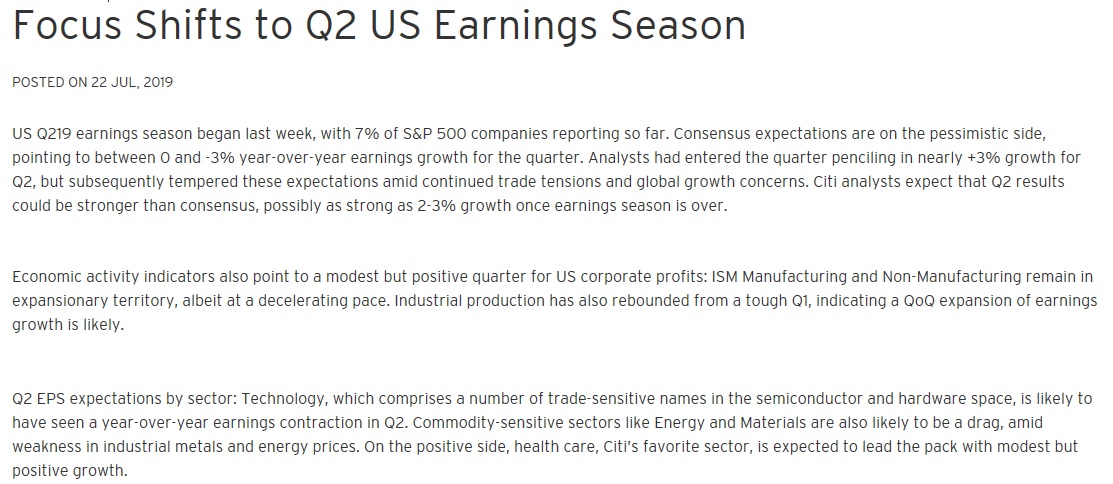
全文US Q219 earnings season began last week, with 7% of S&P 500 companies reporting so far. Consensus expectations are on the pessimistic side, pointing to between 0 and -3% year-over-year earnings growth for the quarter. Analysts had entered the quarter penciling in nearly +3% growth for Q2, but subsequently tempered these expectations amid continued trade tensions and global growth concerns. Citi analysts expect that Q2 results could be stronger than consensus, possibly as strong as 2-3% growth once earnings season is over.
Economic activity indicators also point to a modest but positive quarter for US corporate profits: ISM Manufacturing and Non-Manufacturing remain in expansionary territory, albeit at a decelerating pace. Industrial production has also rebounded from a tough Q1, indicating a QoQ expansion of earnings growth is likely.
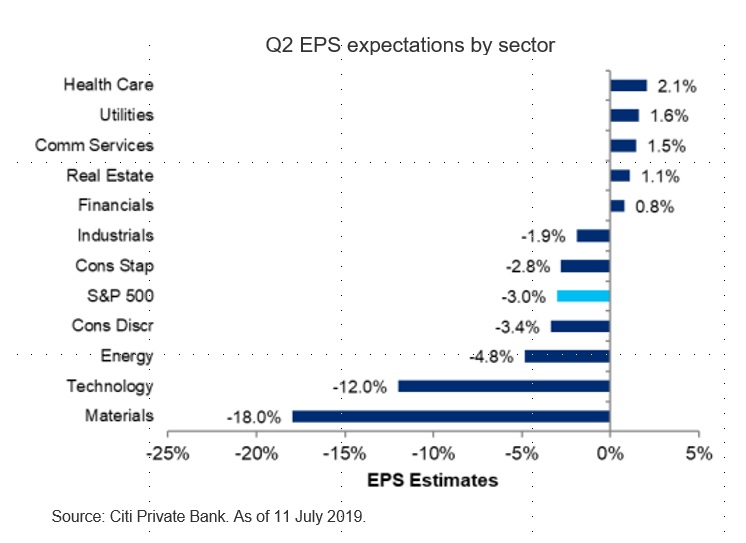
Q2 EPS expectations by sector: Technology, which comprises a number of trade-sensitive names in the semiconductor and hardware space, is likely to have seen a year-over-year earnings contraction in Q2. Commodity-sensitive sectors like Energy and Materials are also likely to be a drag, amid weakness in industrial metals and energy prices. On the positive side, health care, Citi’s favorite sector, is expected to lead the pack with modest but positive growth.
Trade uncertainty has contributed to capex slowdown: A slowdown in capital expenditures so far this year has raised concerns about underlying demand and the prospects for future profits. While some of the trade uncertainty may have been cleared up since the G20 on June 28/29, tariffs on $250 billion of Chinese imports remain in place, while questions persist over trade deals with the EU, Japan, and even US-Mexico-Canada (USMCA) ratification.
Looking ahead to 2020: 2020 consensus Earnings-Per-Share (EPS) forecast of 11% growth appears too high compared to Citi’s 7% estimate and suggests more downgrades to come.